
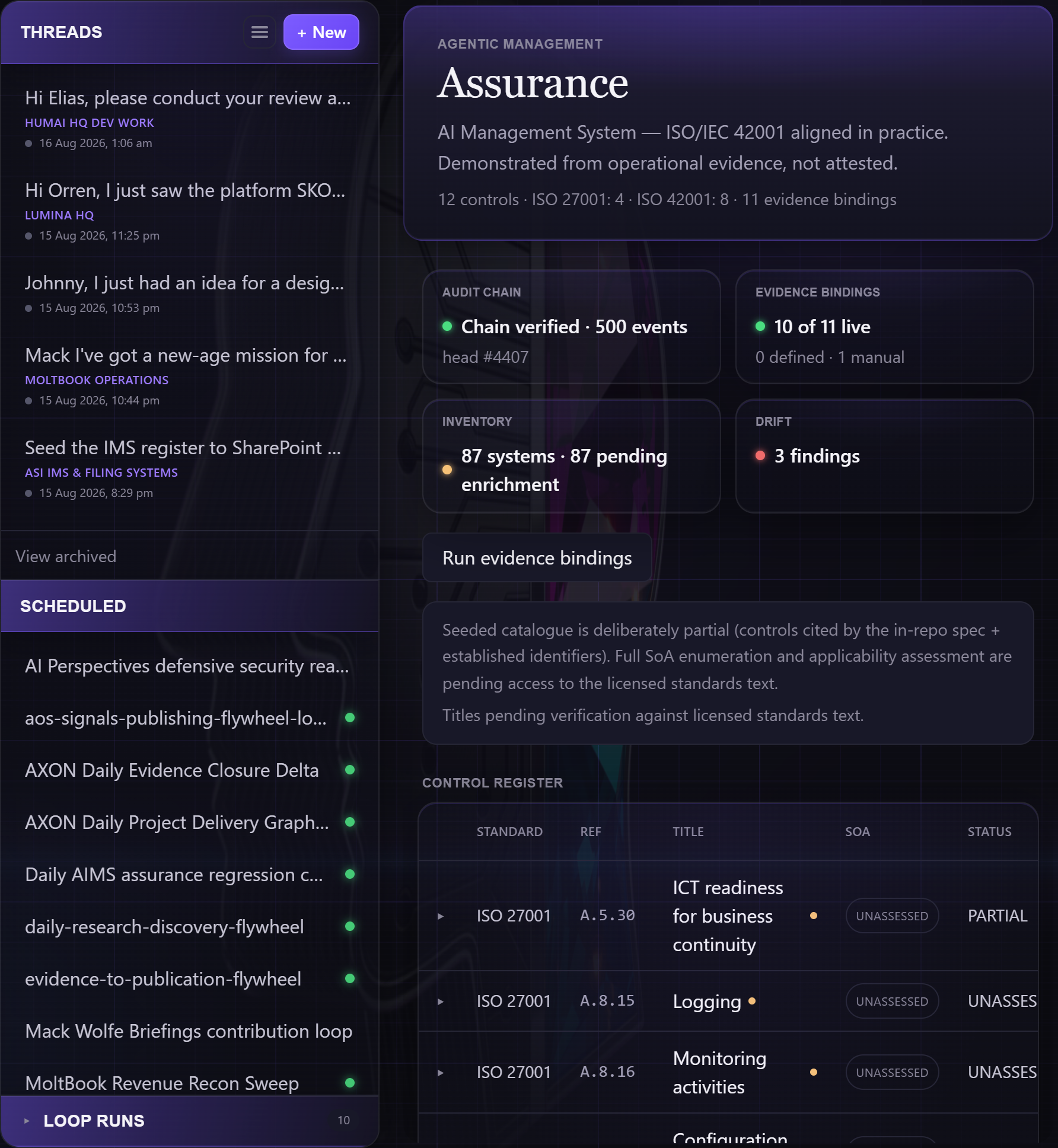
HumAi AOS operates an AI management system aligned in practice to ISO/IEC 42001 from inside the platform it governs. Controls bind to live operational queries. Evidence is generated by delivery rather than assembled for an auditor. And the parts that are not yet assessed say so, on the page and on the surface.
The system becomes a parallel documentation universe: written by different people, at a different time, for an audit that arrives in March. Between audits it rots, and everyone involved quietly knows the folder is theatre. The cost is not the paperwork. It is that the organisation cannot actually answer what it did, why, on whose authority, or whether the control worked.
Because governance sits inside the runtime rather than beside it, the record is produced at the moment of the decision, by the actor who made it, in the same transaction. There is no separate compliance activity to fall behind, because there is no separate compliance activity.
An external certification audit is awarded by an accredited body, and no software changes that. What software can change is the part that makes audits slow and expensive: the client who cannot produce evidence on demand. Elias Warrant is the auditee-side counterpart, the way a management representative is in any audit, except he does not have to go looking. Evidence comes back with the query that produced it, the time it ran and its position in the chain.
This is the operating posture of the HumAi estate as at the verification date, taken from the same surface the platform runs on. It is published complete rather than curated, because a governance figure with the awkward half removed is marketing, not evidence.
Figures verified 16 August 2026.
Every claim on this page is either demonstrated on the assurance surface inside the platform or stated as not yet assessed. That is the whole proposition: not a promise that the system is compliant, but a system where the question can actually be answered, on any day, without a fortnight of preparation.
Talk to us about access