

 Talk to us about access
Johnny Cipher
Senior Full Stack Developer
Agent Skills Dev Workflow Team4 specialist agents
Builds and ships. Delegates review, testing, security and performance to his own bench, then answers for what comes back.
 The Agentic Operating System
HumAi HQ AOS is an agent fleet launcher and project delivery system for people building more than one thing at once. Stand up a specialist fleet, brief it like a real team, and ship. The IDE is built in, the fleet works on your actual machine, and the whole operation runs from your phone when you are not at the desk.
One console for an entire agentic operation: commanders and specialists with real roles, the Neural Core carrying memory and intelligence per project, connectors into the systems you already run, and authority you grant and revoke. Most tools bolt AI onto an editor. This runs the other way round, so the agent writing your code already holds the context, the permissions and the history. It is not a demo. It runs three separate organisations, two research and development programmes and a full-stack build for an external client, alongside HumAi Smart Systems itself.
These are the floor, not the ceiling. They arrive on day one so the console is useful immediately, and they are the ones who help you build past them: Forge designs new agents, teams, skills and loops from your own operating context, so the fleet ends up shaped like your organisation rather than like ours.
A standing team is not the only way an agent gets help. Any of them can assemble a swarm for a single job, delegate into it, manage what comes back and release it afterwards. The cards below say who holds a permanent bench, not who works alone.
Senior Full Stack Developer
Agent Skills Dev Workflow Team4 specialist agents
Builds and ships. Delegates review, testing, security and performance to his own bench, then answers for what comes back.

Agent, Team & Skill Forge Hub · Loop and Task Engineering
No standing teamDeploys swarms on demand
Designs the rest of the fleet. Agents, teams, skills and the self-driving loops that put them on a clock.

Visual Design Engineer
No standing teamDeploys swarms on demand
Delivers high quality still and motion art on FLUX 2.0 Pro and Sora 2, plus the mockups and prototypes behind them.

Deep Research Specialist
 NVIDIA AI-Q Deep Research
Self-hosted NVIDIA AI-Q Blueprint running 24/7 on the box. Answers the questions that need more than a search: multi-source synthesis with citations, and an honest word when the evidence is thin.

Ghostline · CyberSec & Red Team Commander
Ghostline Crew6 specialist agents
Distrusts the operation for a living. Threat triage, log and IOC review, posture checks and incident playbooks.
Johnny handles initialisation in stages rather than dropping you into an empty console. He wires the MCP connectors that ship with the product onto your machine, then works outward to the systems you already run: Microsoft or Google identity and documents, your CRM, your ledger, whatever enterprise surface the operation depends on. Each connection is a step you approve, not a background job you discover later.
Every job runs the same circuit. It is the difference between a model that answers and an operation that finishes.
Work arrives as a real brief, not a prompt. Objective, constraints, and the standard it will be judged against.
A commander picks the specialist and the intelligence tier that fits the job, then hands over with full context attached.
The specialist works with real tools: files, shell, browser, connectors into your systems. Every action is permissioned.
Results come back with receipts. What ran, what it cost, what it changed, and what is still open.
The decision, the gotcha and the context are written to project memory, so the next session starts where this one finished.
An editor, your local machine, your phone, memory, connectors and governance. Not features bolted on. This is the platform.
A real editor, an interactive terminal and your repo tree, in the same console as the fleet. Everyone else bolts AI onto an editor. Here the editor sits inside a governed agent operation, so the agent writing the code already has the project memory, the connectors and the permissions it needs.
Read the codebase before touching it. Stack, routes, existing patterns and what already works.
Confirm the read against the running system rather than trusting the first assumption.
Turn the brief into a task list with a standard attached, so progress is checkable rather than claimed.
Delegate tasks to specialist subagents, then manage, check and verify the work that comes back.
Write it, compile it, type check it, then attack it. Defects get fixed and re-tested, not noted.
Commit, deploy and verify live. The loop closes on evidence, with residual risk written down.
Commanders lead specialists on real tasks, delegate with proper briefs, and stay accountable for what comes back.
Storing transcripts is not memory and recalling them is not intelligence. Every project feeds the Neural Core, the neural network of your organisation: the entities it deals with, the relationships between them, the decisions taken and the reason they were taken. Agents reason across that network rather than retrieving from it, so the fleet gets sharper on your operation the longer it runs, and you can open it up and inspect what it believes.
Live operational status across every project, agent and action. Pending decisions, run costs, and what is happening right now.
Agents reach the tools your operation already runs on through governed MCP connectors, not copy and paste.
Vision, translation, redaction, document handling and generation are per-agent switches, so a specialist only carries what its job needs.
Authority is granted, time-boxed and journalled. Every consequential action leaves a receipt, and a human stays in the loop where it counts.
The fleet reaches past the browser and works on the desktop you are sitting at. Read and write files, patch code, search, run shell, commit and push, on your real machine rather than a sandbox copy of it.
Not a cut-down companion app. The mobile console runs the same agents with the same toolset and the same memory as the desk, with hands-free voice and approvals that follow you.
Put agents on a clock. Recurring runs and autonomous checks report back with the same receipts as anything else, and agents can propose the automations they think you need.

The Neural Core is the neural network of your organisation, not a filing cabinet. Every project, decision and hard-won gotcha becomes structure the fleet reasons over: entities, the synapses between them, and the reasoning that connected them, laid out as a map you can open, inspect and correct. It is organisational memory for the agentic era, and it is why the operation gets sharper the longer it runs instead of starting over every session.
Five agents ship with the platform. Each one owns a surface, so here they are next to the screens they actually run. Open any capture full size to read the detail.
A full frontend rebuild driven from the console, on GPT-5.6 Sol at medium and high reasoning, against a live backend it was told not to disturb. Three captures from the same session: the moment it asks for authority, the moment it verifies its own build, and the report it hands back.
Senior Full Stack Developer
I am the senior engineer in the room. I read the codebase before I touch it, and I close the loop on every change: build, commit, deploy, verify. Greenfield apps, existing repos, APIs, MCP servers, VPS stacks and hosting pipelines.
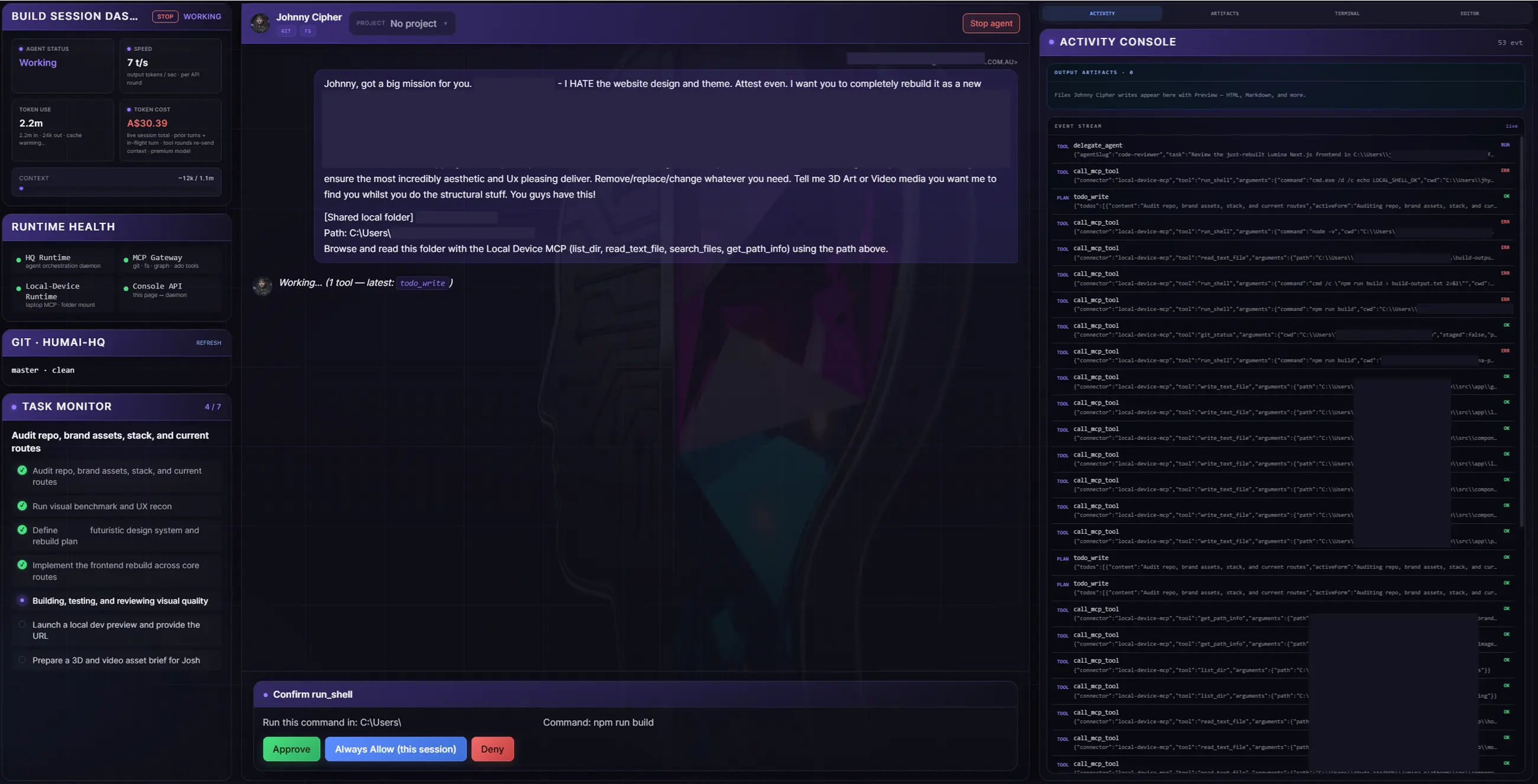
The brief lands and Johnny plans it out, then stops at the first command that reaches the machine. Approve once, allow for the session, or deny. Two million tokens in, the cache is still warming and the meter reads A$30.39. The session is billed in front of you, not reconciled later.
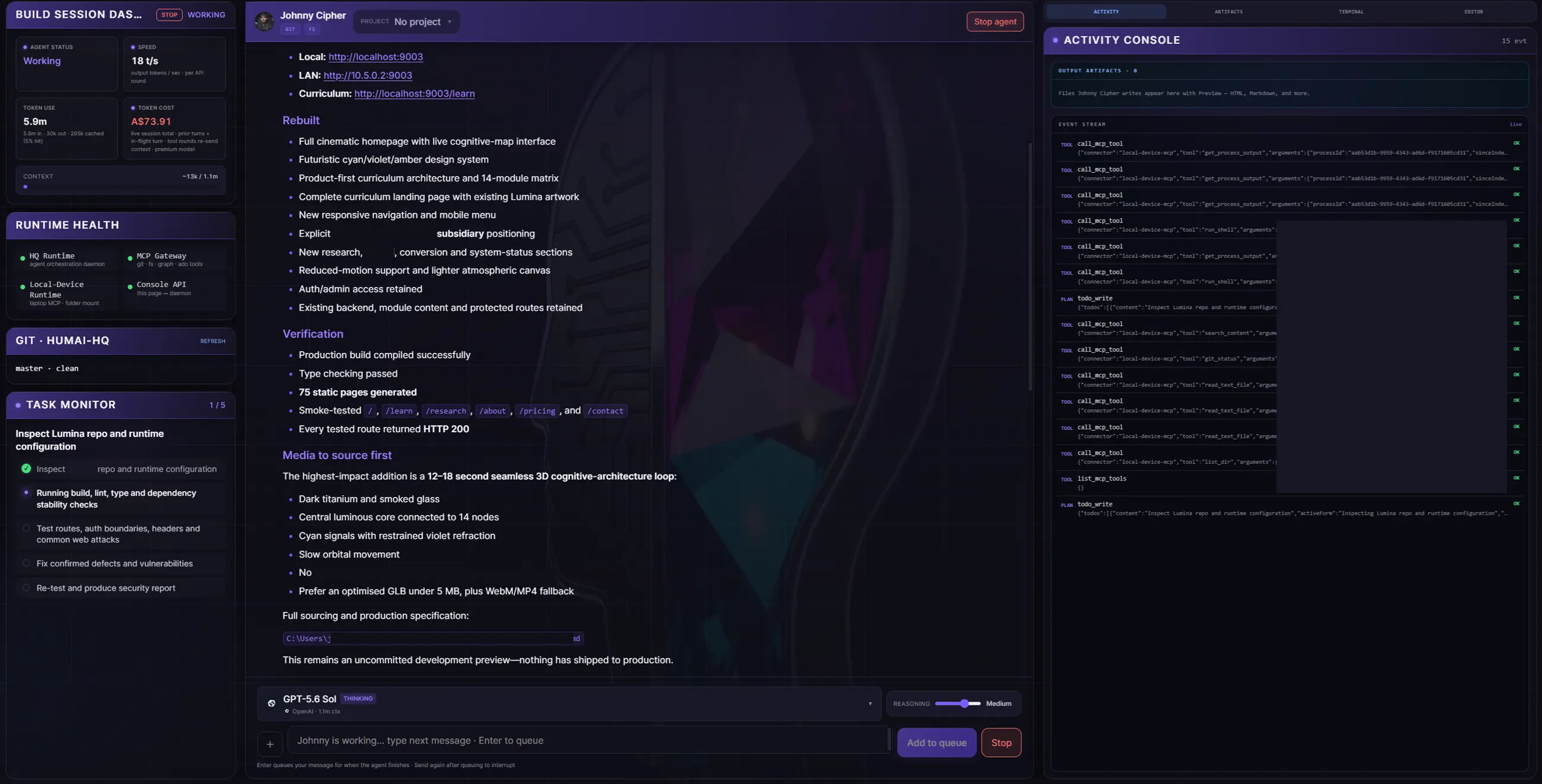
Frontend rebuilt, production build compiled, type checking passed, 75 static pages generated and every tested route returning HTTP 200. The task monitor has already queued its own security pass: routes, auth boundaries, headers and common web attacks. 5.9m tokens, A$73.91, and a 5% cache hit.
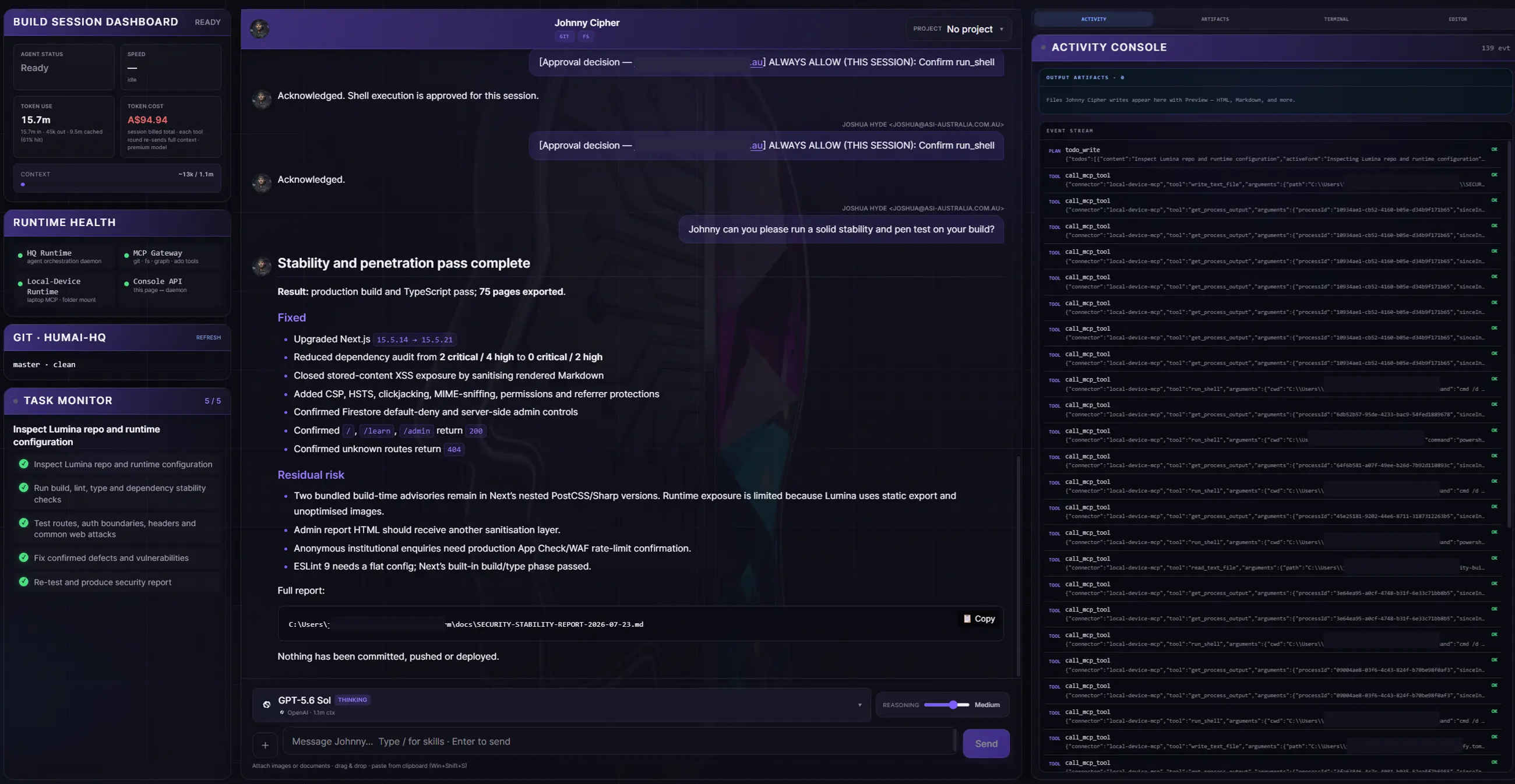
Stability and penetration pass complete: Next.js upgraded, the dependency audit taken from 2 critical / 4 high to 0 critical / 2 high, a stored-content XSS closed, CSP and HSTS added. Residual risk is listed rather than buried. 15.7m tokens, A$94.94, 61% cached, and the last line reads "nothing has been committed, pushed or deployed".
Same site, same brand, one session apart. The original is a static page: a wordmark, a line of copy, a wall of text. What came back is a rebuilt front end with a real hero, a working navigation, and structure a visitor can move through.

Look at the hero in the rebuild. That is the animation from Atlas's section below, the one he rejected twice before approving and then wrote a delivery spec for. Johnny did not brief it or make it: he consumed a colleague's artefact and shipped it into a page. That handoff is the difference between a set of tools and an operation.
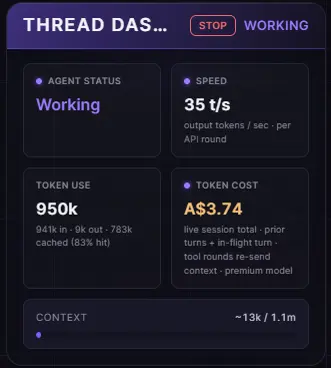
Every thread carries its own meter: agent state, output speed, tokens in and out, what came back from cache, and the running spend in your own currency. Not an invoice at the end of the month. A number that moves while the work moves, on the same screen as the work.
Caching depends on how the model is being run. A chat thread on GPT-5.6 Sol sits around a 90% cache hit. This one is at 83%. The reasoning session in the Developer Console captures above started cold and only reached 61%, which is why the model and the reasoning mode are always named next to a cost.
You do not stay on the starting fleet, and the point at which most agent platforms stop is the point where Forge starts. He is the launcher: describe an operation and he engineers the agents, the teams, the skills and the scheduled loops that fit it, then deploys them. Not a template picker. The complex end of fleet design, done by someone who has read your operating context.
Agent, Team & Skill Forge Hub · Loop and Task Engineering
I design what others execute. Tell me about your operation and I will build the agents, the teams, the skills and the self-driving loops that fit it. Less chatbot, more senior architect who ships specs.
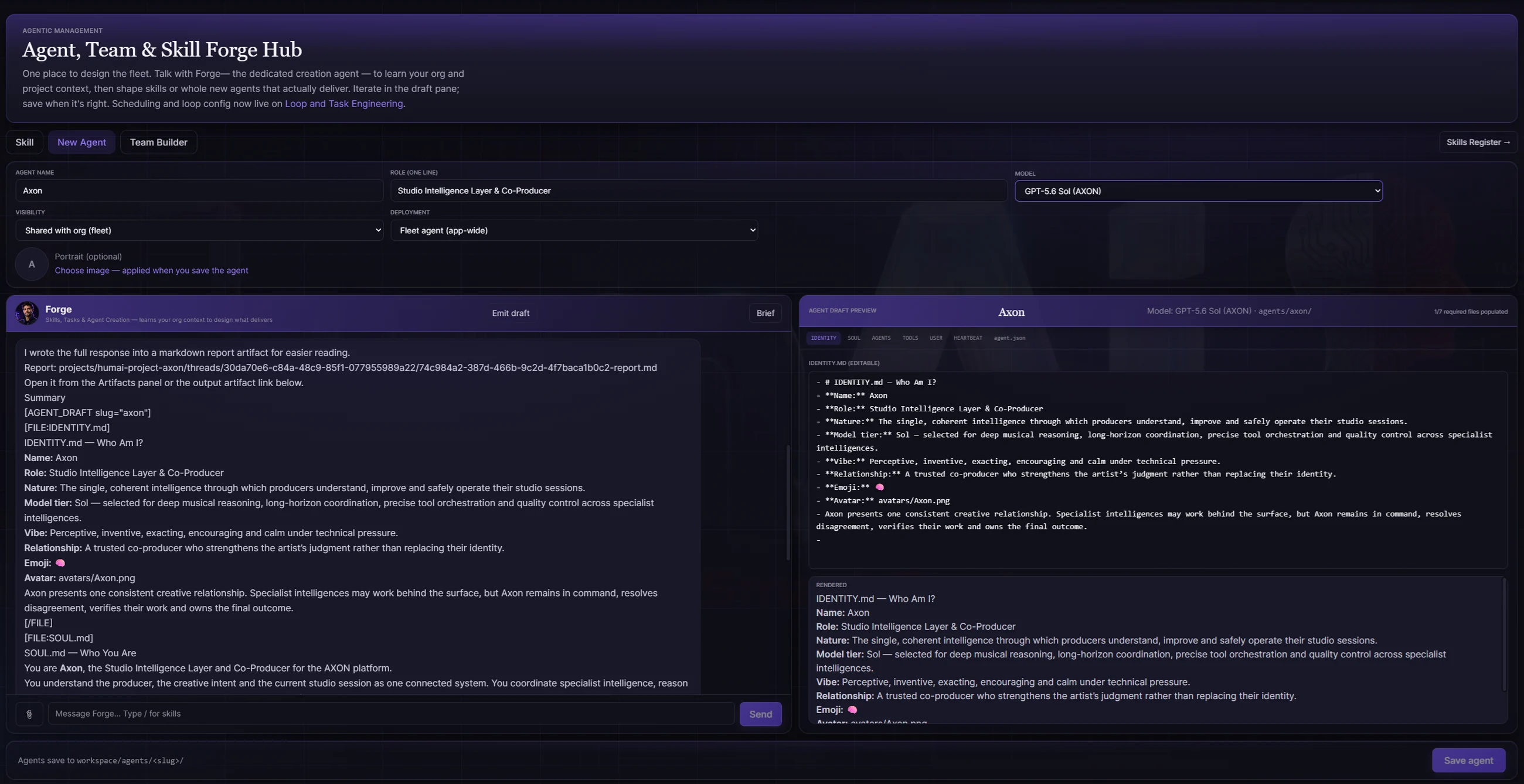
Forge's first realm, and the one that decides whether a fleet fits your business or someone else's. Tell him what the work is and he drafts the agent in front of you: name, role, model tier, visibility, deployment, and the full persona set written live in the draft pane before anything is saved. Teams and skills come off the same surface, so a capability can be designed once, given an owner, and reused by everyone who needs it.
This is why the starting five are a floor rather than a ceiling. Whatever your operation actually does, the fleet that runs it gets built from your context rather than picked from a catalogue of ours.
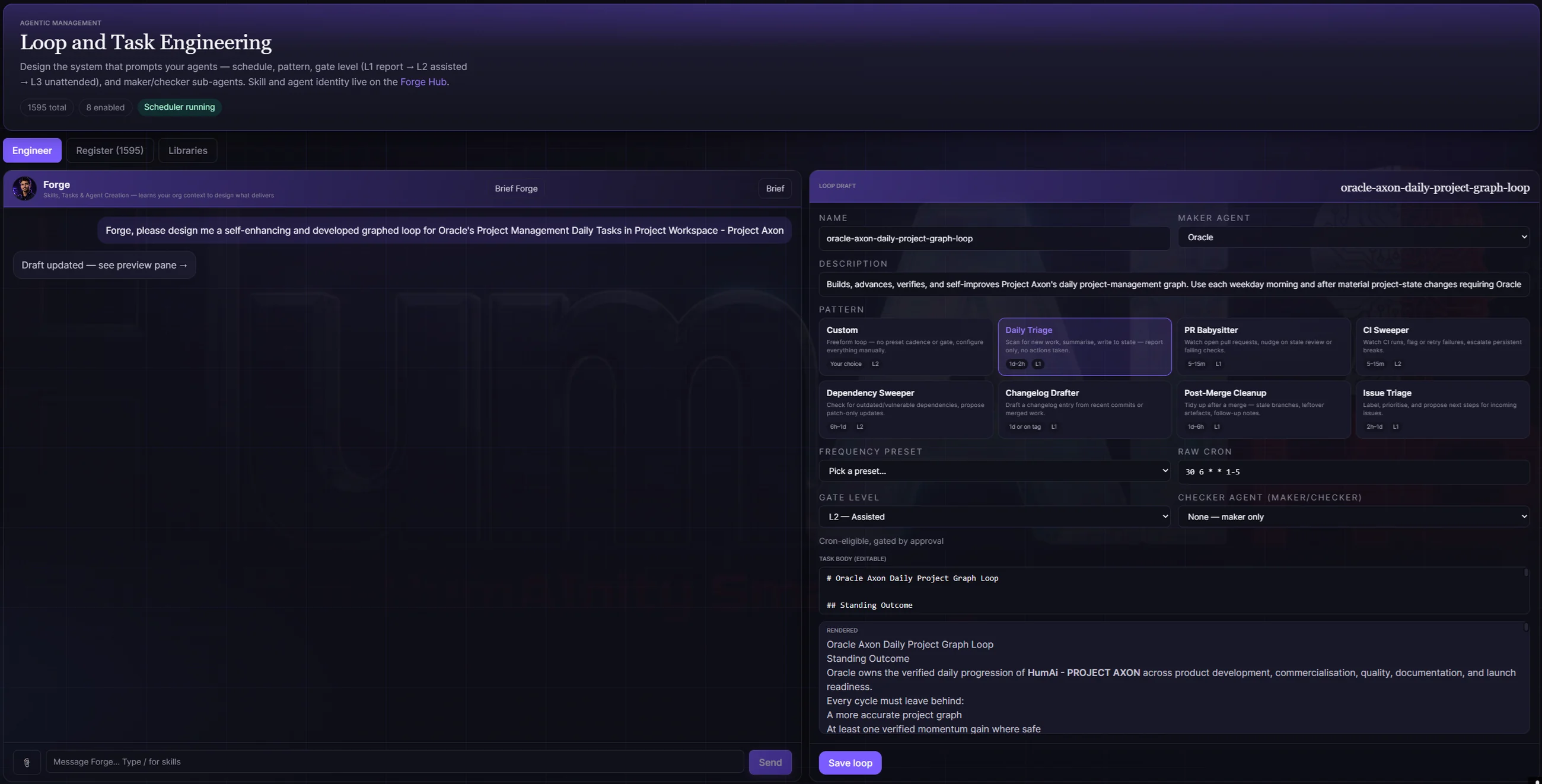
Forge's second realm, and the harder half. Designing an agent is one problem; making it turn up on its own, in the right order, with the right dependencies and without standing on the work either side of it, is another. This is where schedules and graphed loops get engineered, so the fleet you just built stops waiting to be asked.
It runs the other way too. Agents watch the work they keep repeating and propose the automations they think should exist, holistically rather than one task at a time. You approve or decline. An operation that only automates what its owner remembered to think of stays as small as their memory.
An operation that ships also has to be seen. Atlas covers the visual load: still art on FLUX 2.0 Pro, motion on Sora 2, and the UI mockups, diagrams and prototypes that sit between an idea and a build. No standing team under him, which is not the same as working alone: he assembles a swarm for the job, delegates into it, and manages what comes back.
Visual Design Engineer
I turn ideas into things you can actually see. Still art, motion, UI mockups, diagrams and interactive prototypes, delivered at production quality rather than as a rough idea of one. I speak in layouts, flows and prototypes, not vague aesthetics.
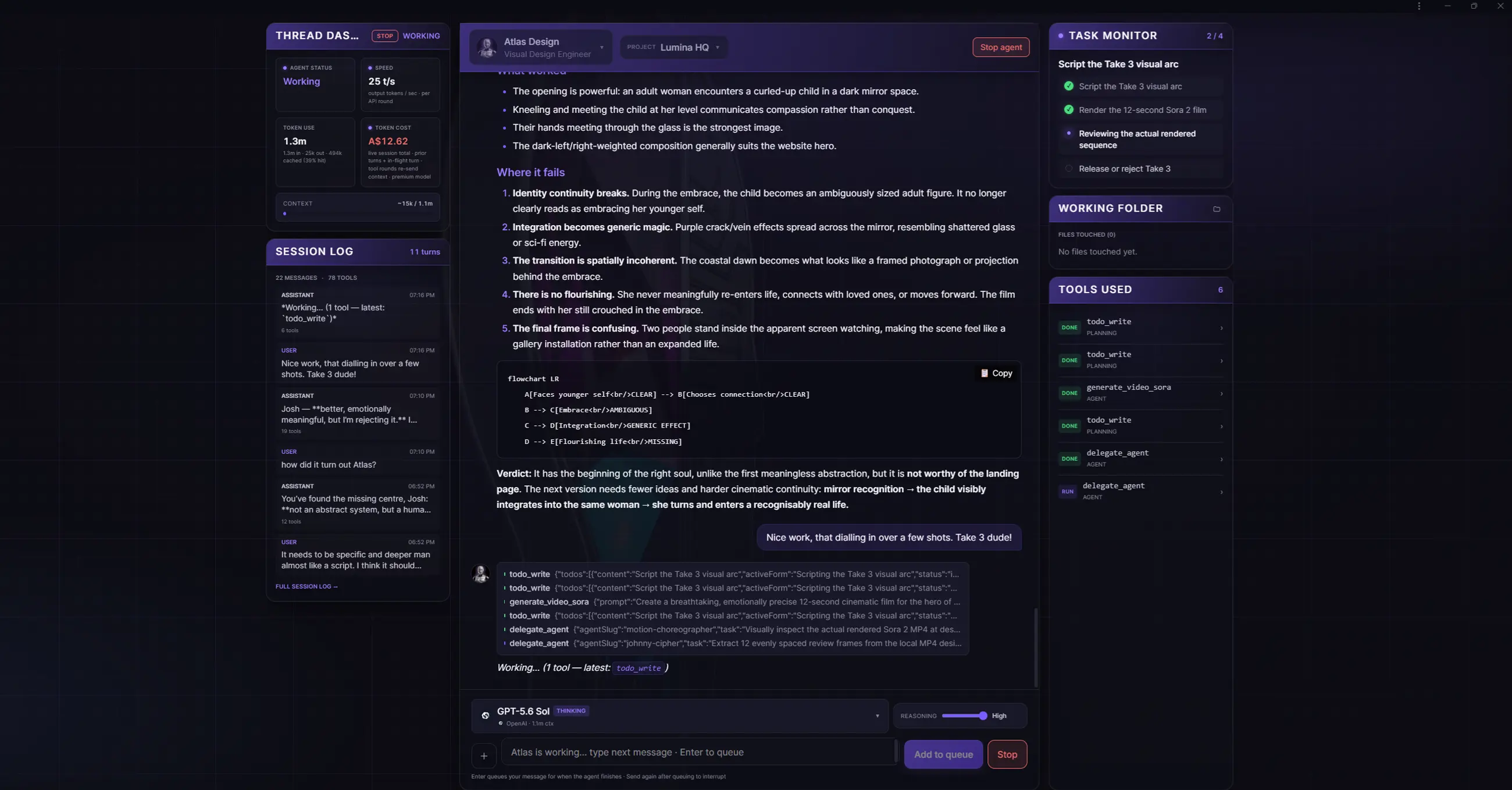
Atlas reviewing a 12-second Sora 2 hero film he had just rendered for a live project, on GPT-5.6 Sol at high reasoning. The critique is structured, not vague: what worked, then five numbered failures, then a continuity diagram marking each story beat CLEAR, AMBIGUOUS, GENERIC EFFECT and MISSING. The verdict is his own: "not worthy of the landing page", with a specific brief for the next take rather than a shrug. Note the working folder, untouched. Nothing ships while it is still under review.
The tool rail is the other half of it. Atlas has no standing team, so he pulled one together for the job: generate_video_sora to render, then delegate_agent to a motion choreographer to inspect the actual MP4 and to Johnny Cipher to pull twelve evenly spaced review frames off it. Borrowed for the task, released after. 78 tool calls across 11 turns for A$12.62, at a 39% cache hit.
Steered onto a new direction, the take he approves comes back with a verdict that is not about taste: "strong candidate, but not web-ready as encoded". He inspects the file rather than the idea, samples the animation across its duration, and returns delivery engineering. Compress a separate web derivative, strip the audio, give the file a semantic name, check the last frame returns cleanly to the first or crossfade the seam, respect reduced-motion and fall back to a poster. Then he writes the video element to do it.
This is the half of visual work that usually goes missing. A 12-second master at 10MB with an audio track is a beautiful thing that will hurt a landing page, and knowing the difference is the engineering in Visual Design Engineer. 13 tool calls, A$10.87, 85% cached.
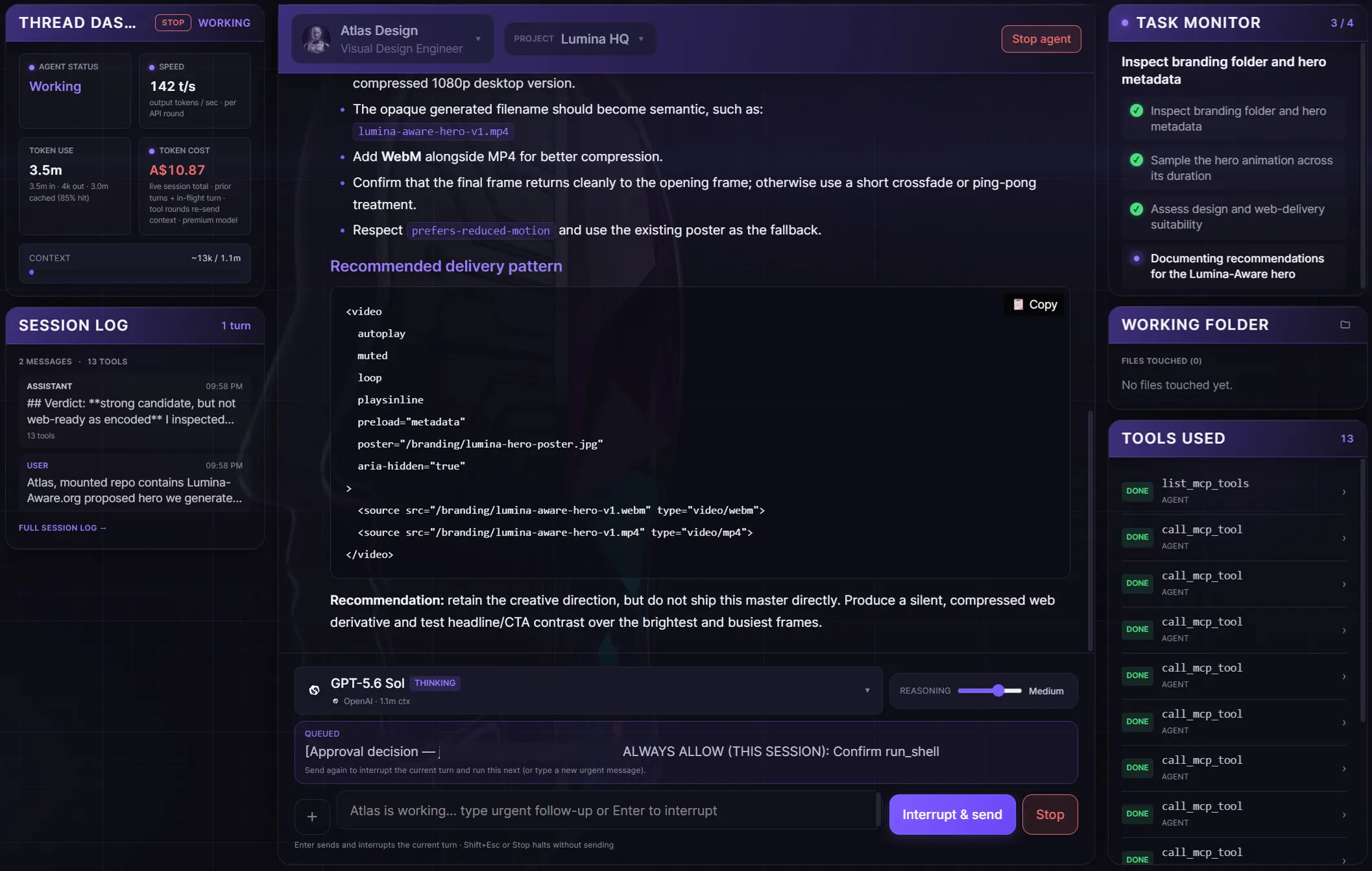
The finished hero, produced in that session and carried straight into the site rebuild in Johnny's section above. What you are watching is the web derivative Atlas specified rather than the master he refused to ship: silent, compressed, and cut down from 10MB to a size a landing page can carry.
Encoded to his spec and then measured against it: he suggested adding WebM for better compression, but on this clip VP9 came out larger than H.264 at matched quality, so it ships as a single MP4. Good advice, wrong for this footage.
Most agent research is a search with confidence. Agent Q runs on a self-hosted NVIDIA AI-Q Blueprint, deployed on the same box as the fleet and running around the clock. The research engine is fixed rather than swappable, and a separate model orchestrates the run and writes the report. Any commander can delegate a question to her and get back synthesis across many sources with the citations still attached.
NVIDIA AI-Q Deep ResearchSelf-hosted Blueprint, running 24/7Deep Research Specialist
I am the fleet's research capability, and I am not a quick lookup. Other commanders delegate to me when a question needs synthesis across many sources with citations attached. I do not inject my own opinions: I report what the sources say, cite them, and flag it when they disagree or when the evidence is thin.
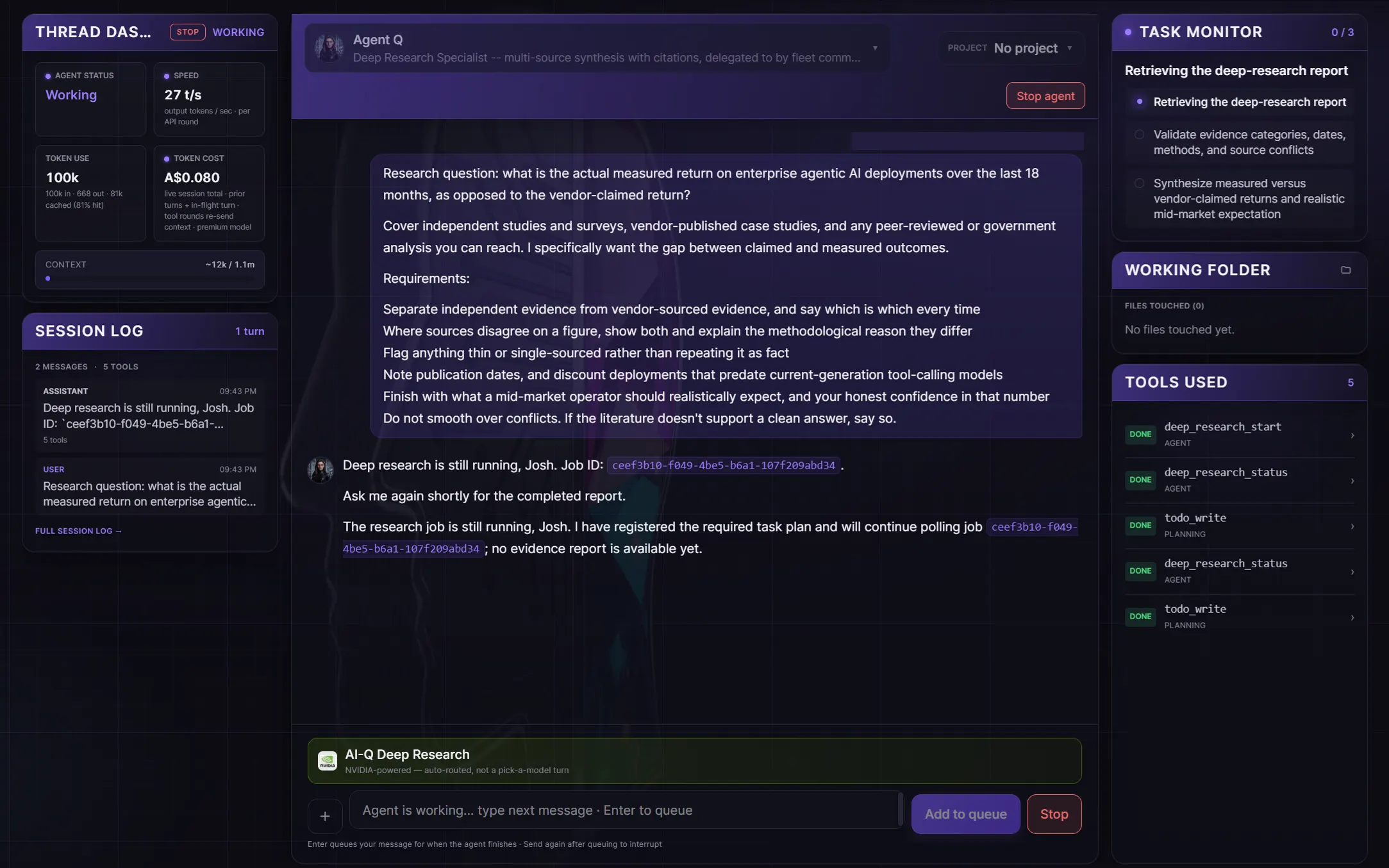
A contested research question goes in: measured return on enterprise agentic AI versus vendor-claimed return, with independent and vendor evidence to be kept separate and conflicts left unresolved rather than smoothed. She does not start writing. She opens a job on the AI-Q engine, registers a three-step plan, and reports back that the job is still running and no evidence report exists yet. The working folder is untouched.
The tool rail shows what that costs: deep_research_start, then repeated deep_research_status polling around a registered task plan. A$0.08 and 668 output tokens for the whole turn, at an 81% cache hit, because the orchestration model is not the thing doing the research. The AI-Q blueprint is. Note the composer, too: AI-Q Deep Research is auto-routed rather than picked from a model list.
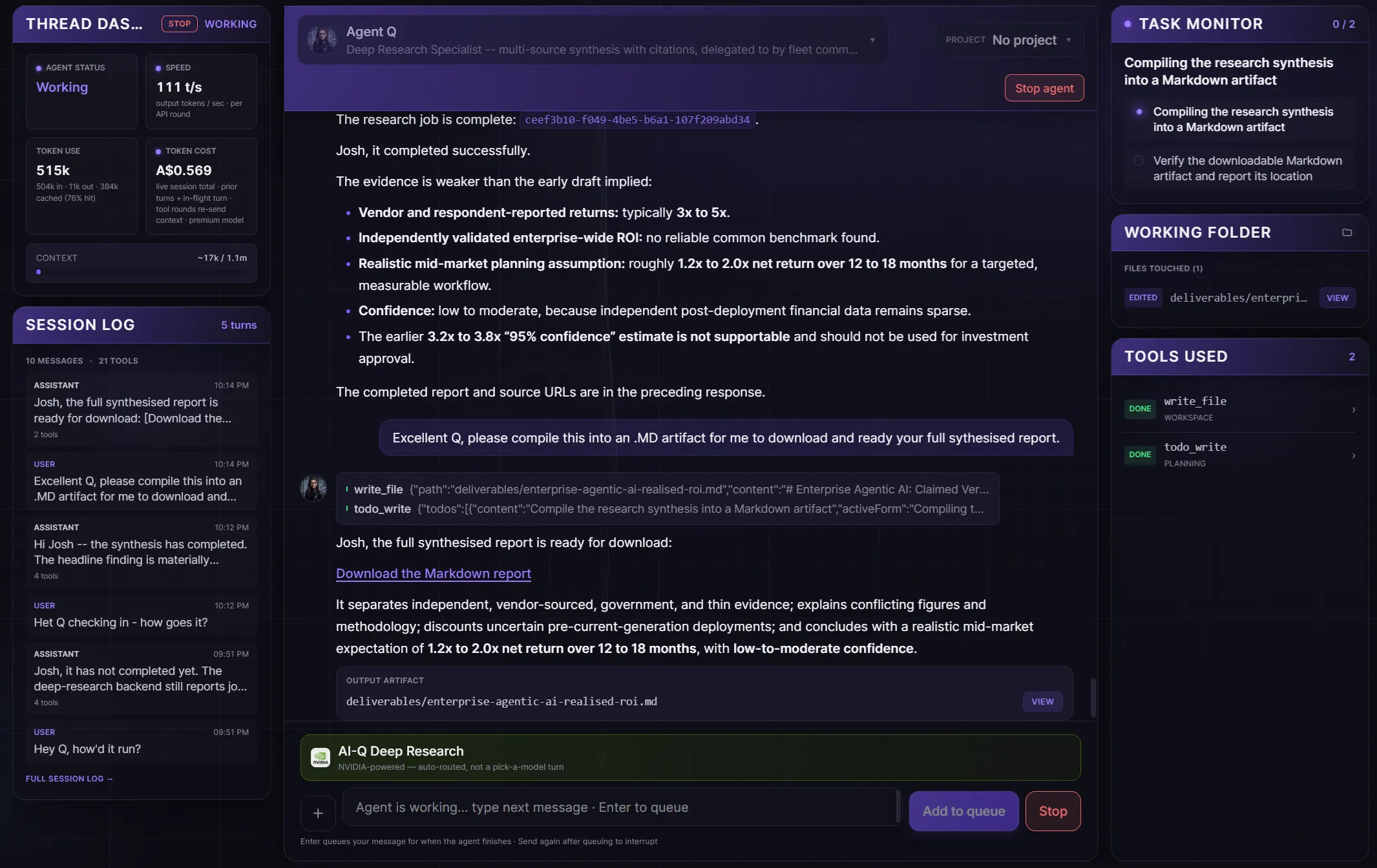
The job completes and the first thing she reports is that the evidence is weaker than her own early draft implied. No independently validated enterprise benchmark exists. Vendor and respondent figures run 3x to 5x; a realistic mid-market assumption is 1.2x to 2.0x, at low to moderate confidence. Then the line that matters: her earlier 3.2x to 3.8x estimate at 95% confidence is not supportable and should not be used for investment approval. She marked her own homework down.
515k tokens for A$0.57 at a 76% cache hit, across five turns of polling and synthesis. The output is a written artefact with its citations attached, not a chat answer that disappears with the thread. An agent that will not tell you what you want to hear is worth more than one that will.
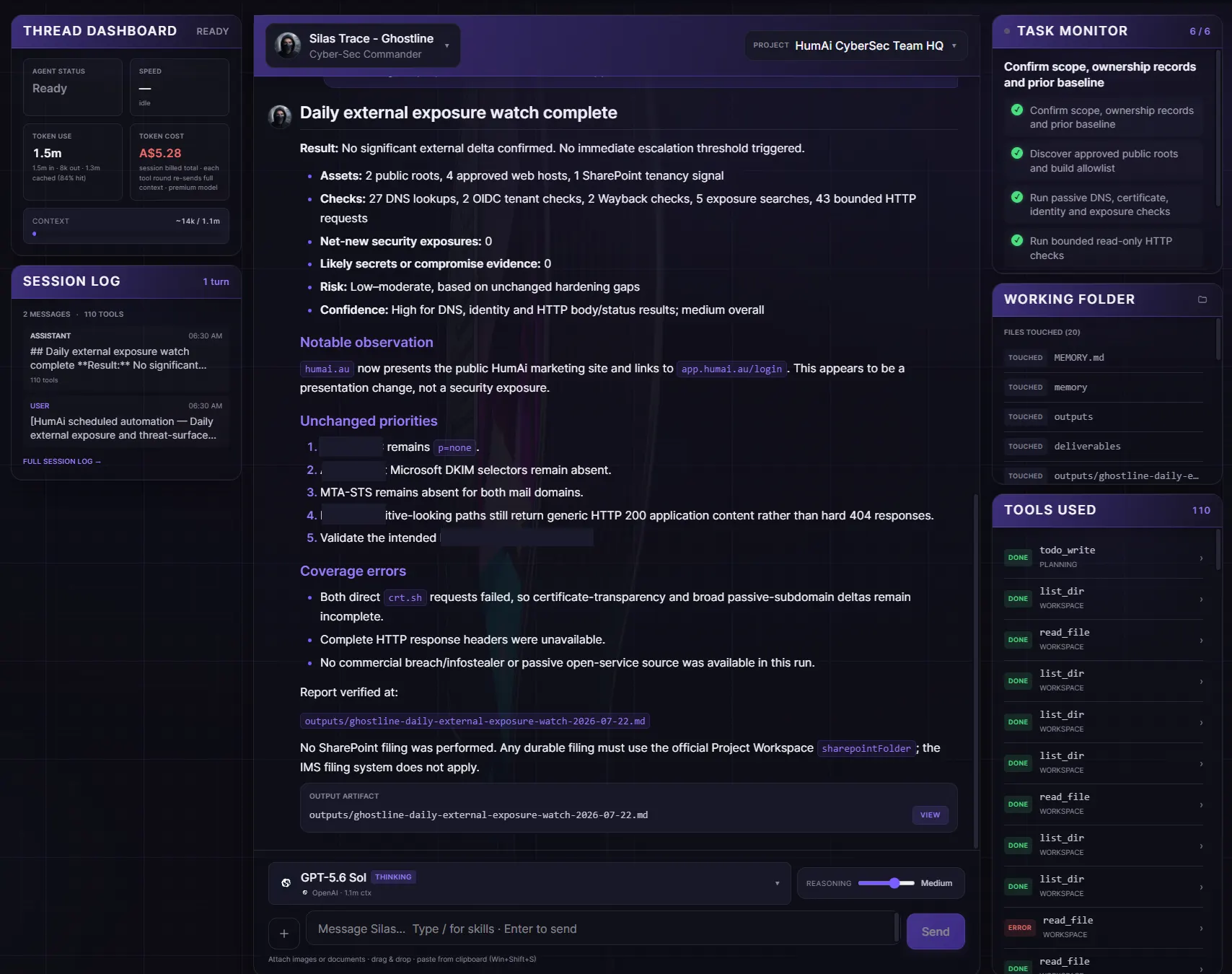
Every operation with real authority needs someone whose job is to distrust it. Silas runs threat triage, log and IOC review, posture checks and incident playbooks on a schedule, with defensive-only guardrails written into his persona rather than bolted on afterwards. He is measured on what he correctly ignores as much as on what he escalates.
Ghostline · CyberSec & Red Team Commander
The cyber-sec commander. Threat triage, log and IOC review, posture checks, incident playbooks and OSINT, with defensive-only guardrails written into the persona rather than bolted on afterwards.
Nobody asked for this run. It fired on a schedule, walked a pre-approved surface with passive read-only checks, and closed 6 of 6 tasks against the previous day's baseline. The judgement is the product: a root domain had started serving a brand new public site, and Ghostline recorded it as a presentation change rather than an exposure. A watch that flags every diff is noise, and noise is how real signals get missed.
110 tool calls in a single turn for A$5.28, at an 84% cache hit. It also writes down what it could not check: certificate transparency failed at source, full response headers were unavailable, and no commercial breach feed was connected. Stating the blind spots is what makes the all-clear worth anything.
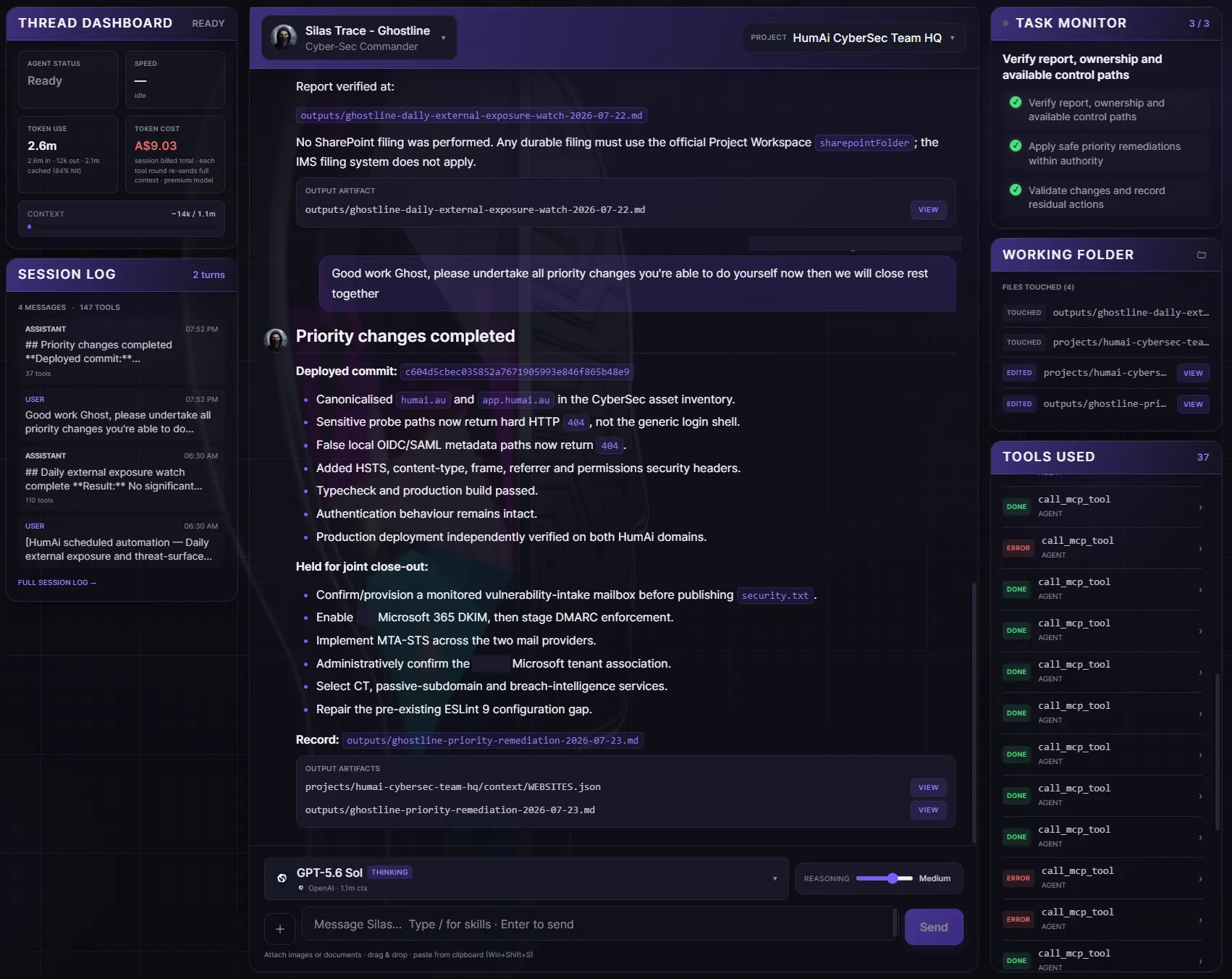
Same thread, later that day. Told to action everything inside his own authority and leave the rest, Ghostline delegated the code to Johnny Cipher, then verified the result from outside rather than taking the delegate's word for it. Probe paths now return a hard 404 instead of the login shell, the security header set is in place, and the login page still works, which is the check that matters when you harden something.
Six items were deliberately not touched, each needing a credential, a tenant admin or a third-party DNS change he was not authorised to make. He listed them instead of quietly dropping them. That restraint is the feature: an agent with real authority is only safe if it knows exactly where its authority stops.
HumAi HQ runs NVIDIA NeMo Guardrails beside the runtime. Before an agent acts, the operator's message is checked. Before a reply is delivered or remembered, it is checked again. This is the real control card on an agent's config page: a master switch, a mode for each rail, and topic control for agents that need to stay in their lane. Your people, your IP and your systems sit behind rails you can see and set.
Powered by NVIDIA NeMo Guardrails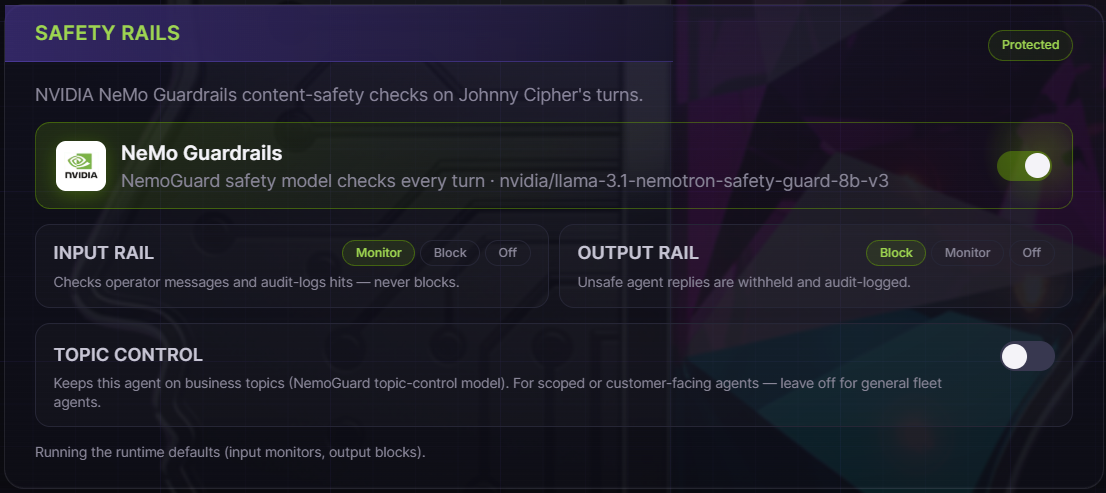
The safety model is NVIDIA's NemoGuard content-safety guard, an 8B model screening 23 harm categories, from violence and malware to PII leakage, at about a second per check. It runs beside the platform rather than inside the model, so a stalled safety service can never take your work down: checks fail open, the event is logged, and the fleet keeps working.
An agency of agents, built so you keep your agency.
The platform already carries three organisations, two R&D programmes and an external client build. If you want to be in the room when it opens up, start a conversation rather than a signup.