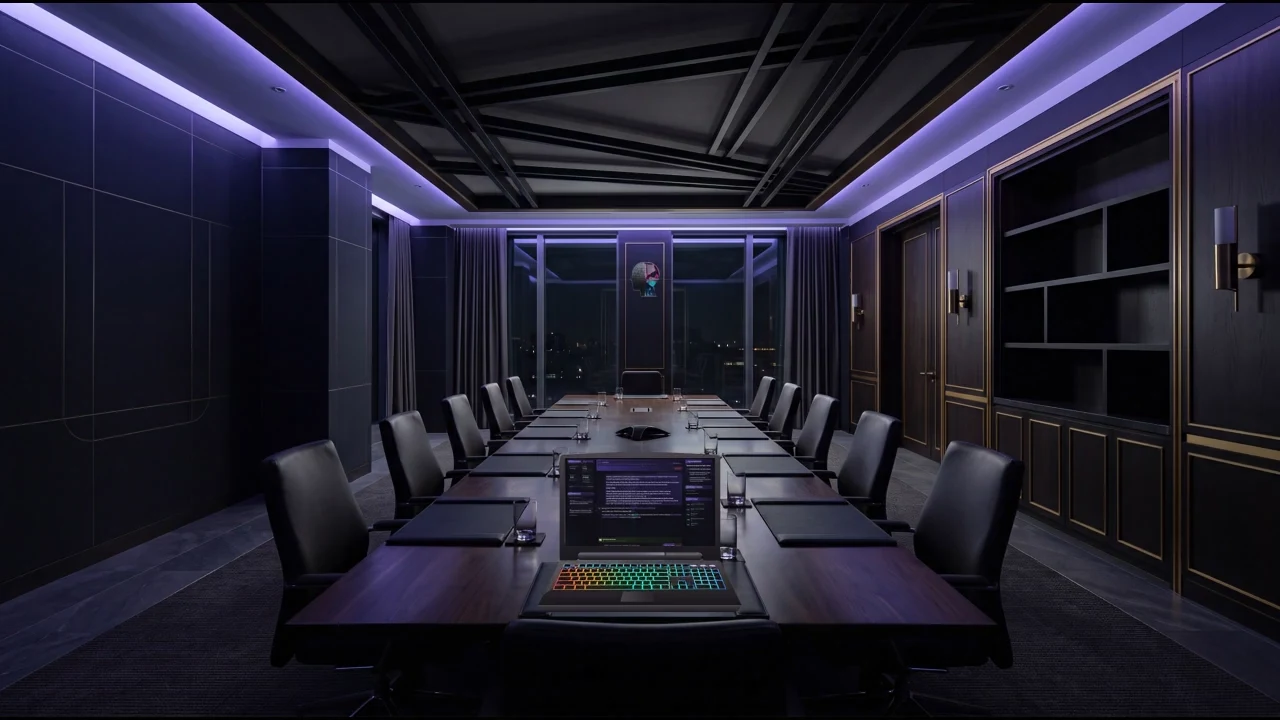

This is the Boardroom of the HumAi AOS Harness: a governed board of AI specialists, convened in one sitting. Watch it take an initiative through all five gates, catch what the pack got wrong, and release governed delivery with every condition owned.




The board is convening. Otto Kren takes the chair.
Illustration. The chamber, the agents, the gates, the register and the decision vocabulary are the product's own; the initiative and its findings are written for this walkthrough.
The hard part of governance has never been the framework. It is getting the right dozen people in one room, at one time, all of them having read the pack. That is a scheduling problem wearing a capability costume, and it is why the output is so often poor: the quality ceiling was set by whoever happened to be free.
The months this normally takes are not slow because the thinking is hard. They are slow because the right dozen people are never free at once, and when they finally are, half have not read the pack. That is a scheduling problem wearing a capability costume, and it is why the output is so often poor: the quality ceiling was set by whoever happened to be available. A fleet removes the constraint rather than working faster. Every specialist convened on demand, all of them having read everything, none of them fatigued at four on a Friday.
Decide well at the front, with the right specialists present and the evidence in the room, and delivery inherits that quality instead of spending its budget recovering it. The expensive discovery happens while it is still cheap to act on, rather than after the money is committed, which is when finding it is worth the least.
The gates are the spine of the room. Each one has a decision attached, and the board does not move past it until that decision is on the record.
Most of what makes someone effective in a director's chair is not talent. It is knowing which questions to ask, in what order, and refusing to move on until each one is answered. That is a sequence, and almost nobody is ever taught it. The gates encode it, so the structure carries the expertise and the person carries the decision. Someone who has never written a line of code, never used an AI system and never run a project can sit at the head of the table and be asked the right things in the right order, by specialists who have read everything and will say when the answer is not good enough.
The five gates are one discipline, run end to end in one harness. The board holds the decision authority, every decision becomes a record the moment it is made, and the same harness that made the decision carries the work through plan, owners and provisioning into governed delivery. That is the AIMS Governed Harness: hyper-delivery with the governance produced by the work itself.
Because the decision is taken in the system that runs the work, the record is produced at the moment of decision, by the actor who made it, in the same transaction. Nothing is reconstructed afterwards for an auditor, which is the single reason management systems decay.